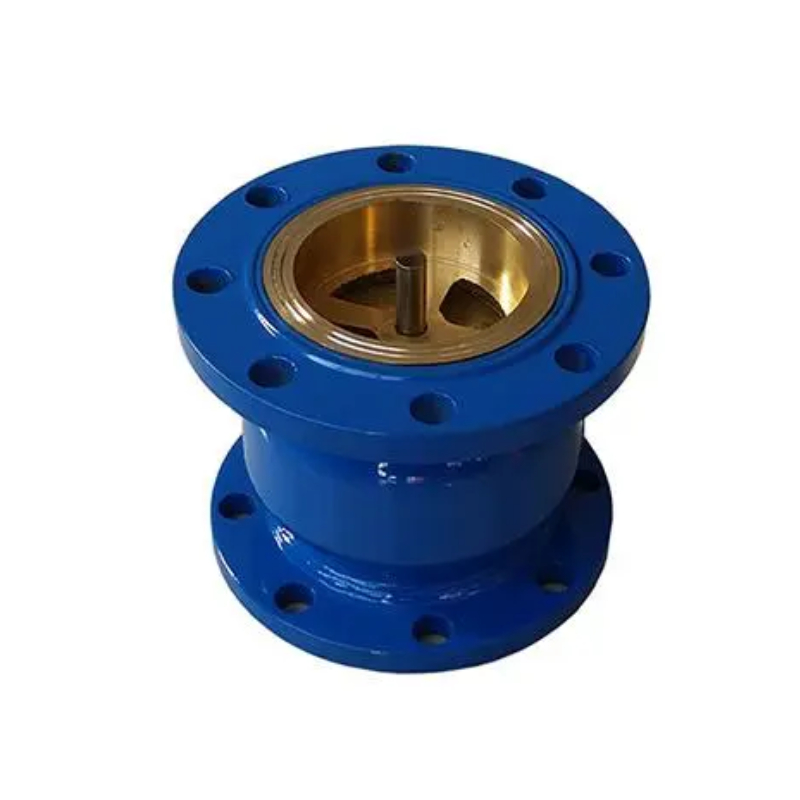

Silencing Check Valve
A silent check valve relies on the flow of the medium to automatically open and close the flap, helping prevent backflow. It is an automatic valve used to stop medium backflow, avoid pump and drive motor reversal, and prevent unintended discharge from the container; it may also be used in auxiliary systems where pressure needs to rise above system pressure for recharging the pipeline. Silent check valves are also known as check valves, muffled check valves, backflow valves, and backpressure valv
Product Description
The purpose of a muffler check valve is to prevent reverse flow while allowing flow in one direction only. In typical designs, the valve is automatic: when fluid pressure acts in the intended flow direction, the valve opens. When flow reverses, the combination of the fluid pressure opposite to the intended direction and the valve flap’s self-gravity seats the flap, cutting off reverse flow. This valve is not suitable for media containing solid particles or for highly viscous media.
What is a Silent Check Valve?
A silent check valve is an essential component in various piping systems. It prevents backflow while minimizing hydraulic shock. Unlike traditional check valves that rely on a weighted disc or ball, silent check valves use a distinct mechanism designed to significantly reduce operating noise. This makes them particularly suitable for applications where low noise is required, such as residential and commercial plumbing, HVAC systems, and fire protection systems.
The primary function of a silent check valve is to permit flow in one direction and automatically close to prevent reverse flow. This is achieved by a spring-loaded mechanism that responds quickly to changes in fluid pressure. When flow stops or begins to reverse, the disc closes tightly to prevent backflow, safeguarding system integrity and helping protect equipment from potential damage.
One of the key advantages of silent check valves is their ability to reduce water hammer. Water hammer occurs when moving fluid is forced to stop suddenly, creating pressure surges that may damage pipes and generate noise. The design of silent check valves helps mitigate these effects by enabling a smoother transition for the fluid, improving the overall service life and performance of piping systems.
In commercial and industrial applications, installing silent check valves can reduce maintenance costs and repairs caused by leaks or equipment failure. Their reliable operation in ensuring unidirectional flow, combined with quieter performance, makes silent check valves a preferred choice for engineers and system designers.
In summary, a silent check valve is a critical device for effective flow control and backflow prevention, distinguished by its noise-reduction characteristics compared with conventional alternatives.
Dual Defense: Noise Cancellation & Water Hammer Protection – How Silencing Check Valves Quiet Pump Rooms
STORAEN’s silencing check valve improves pump system safety and comfort by combining two critical functions—water hammer prevention and noise reduction—into a single engineered solution. Unlike traditional check valves that cause disruptive “hammering” noises and destructive pressure surges, our design integrates a spring-loaded slow-closing mechanism with noise-dampening materials. This makes it well-suited for commercial buildings, industrial plants, and residential complexes where quiet operation and pipeline protection are essential.
1. Water Hammer Protection: The Science of Controlled Closure
At the core of our silencing check valve is a precision spring-loaded disc that supports gradual closure to suppress water hammer:
Dual-Stage Shutoff: When pump flow stops, the disc closes rapidly by 80% (typical, within 0.5 seconds) to arrest backflow, then the final 20% closes slowly over 3–15 seconds (adjustable via a needle valve). This reduces pressure surges to ≤1.3x working pressure—typically 40% more effective than standard check valves.
Rugged Construction: A ductile iron or 316L stainless steel body supports pressures up to 2.5 MPa and temperatures from -10°C to 80°C, while a stainless steel spring resists corrosion to help achieve 50,000+ cycles in demanding environments.
2. Noise Reduction: Engineered for Quiet Operation
Three design features work together to reduce the harsh “slam” associated with conventional valves:
Rubber-Infused Sealing: An EPDM/NBR rubber-coated disc forms a soft, impact-absorbing seal, reducing closure noise by 40% compared with metal-to-metal contact.
Streamlined Flow Path: A waist-shaped valve body minimizes turbulence during forward flow, reducing hydraulic noise (≤70 dB) by half—ideal for pump rooms adjacent to offices or living spaces.
Non-Metallic Lubrication Guide Sleeve: A PTFE-coated guide sleeve reduces friction between the disc and valve body, eliminating the high-pitched squeaks commonly seen in unlubricated valves.
3. Versatile Design for Diverse Applications
Available in sizes DN40 to DN500 with flange connections (ASME B16.5/GB/T 17241.6), our silencing check valves can be used across a variety of systems:
Commercial Buildings: Install at pump outlets in high-rise water supply systems to protect pipelines and help maintain tenant comfort.
Industrial Plants: Suitable for dirty water or mild slurries, supported by a debris-resistant disc design that helps prevent clogging while reducing noise in manufacturing facilities.
Residential Systems: Designed for quiet pump room operation, with lead-free brass options meeting FDA requirements for potable water.
Upgrade to Quieter, Safer Fluid Control
Don’t let noise and water hammer compromise system performance. STORAEN’s silencing check valves provide the dual protection you need—quiet operation and robust backflow prevention—engineered to help extend pump life, reduce maintenance, and create more comfortable environments.
Whether you’re upgrading a commercial pump room or designing a residential water system, our silencing check valves provide the right balance of safety and serenity. Explore our range today and discover why engineers and industry partners trust STORAEN for reliable, noise-free fluid control.
Swing vs. Lift Type: In-Depth Noise Reduction Principles of Silencing Check Valves
Choosing between swing-type and lift-type silencing check valves depends on understanding their distinct noise reduction mechanisms and operational strengths. STORAEN offers both designs, each optimized for specific flow-control needs. Below is an overview of how they work and where they deliver the best noise and safety performance in quieter pipeline systems.
1. Swing-Type Silencing Check Valves: Low-Noise Flow with Angular Movement
Swing-type valves feature a disc hinged at the top that rotates to open and close around a horizontal axis:
Noise Reduction Mechanism:
A rubber-coated disc (EPDM/NBR) with a soft-seat design absorbs impact during closure, reducing “slam” noise by 35% compared with metal-only valves.
A damping spring slows disc rotation, supporting gradual sealing in low-pressure systems (≥0.05 MPa) and minimizing vibrations associated with water hammer (noise ≤75 dB).
Best For:
Large-diameter pipelines (DN80–DN600) in industrial water systems or HVAC loops, where the full-bore design helps reduce pressure loss by 20% versus lift types.
Moderate-pressure applications (≤1.6 MPa) with clean media, since the hinged design is less prone to debris blockage.
2. Lift-Type Silencing Check Valves: Precision Closure for High-Pressure Quietness
Lift-type valves use a vertically moving disc guided by a stem, providing tighter control under high-pressure conditions:
Noise Reduction Mechanism:
A dual-guide rail system stabilizes the disc’s vertical motion, eliminating lateral wobble and metallic screeching typical of unguided designs.
A short-stroke design (25–50 mm) combined with a heavy-duty spring ensures rapid yet controlled closure (0.3 seconds for DN50), reducing pressure surge noise by 40% in systems up to 2.5 MPa.
Best For:
Small to medium diameters (DN15–DN200) in residential or commercial buildings, where space is limited and quiet operation is critical (noise ≤65 dB in domestic water systems).
High-pressure applications such as boiler feed lines, supported by the ability to handle temperatures up to 150°C using stainless steel 316 components.
Key Design Differences for Noise Control
Sealing Surface: Swing types use wide, angled seats for gradual contact; lift types rely on narrower, flat seats for instantaneous but cushioned closure.
Flow Turbulence: Swing valves use a streamlined path that reduces turbulence in low-speed flows; lift valves include a vertical stem that creates minor resistance, but perform strongly in high-velocity, noise-sensitive environments.
Maintenance Needs: Lift valves require periodic lubrication for guided stems (PTFE-coated sleeves in STORAEN models reduce friction by 30%); swing valves depend on clean media to prevent sticking at hinged joints.
STORAEN’s Engineered Solutions for Every Scenario
Swing-Type Advantages: Optional epoxy lining for corrosive media, ASME B16.5 flanges for broad compatibility, and noise tests compliant with ISO 3744 (acoustic engineering standards).
Lift-Type Innovations: Patented spring preload adjustment (0–10 N·m) to fine-tune closure speed, ideal for customizing noise levels in sensitive environments such as hospitals or hotels.
Choose the Right Type for Your System
Prioritize space & low pressure: Select swing-type silencing check valves for large pipelines.
Need high pressure & precision: Choose lift-type silencing check valves for compact, high-demand setups.
Both STORAEN designs provide reliable backflow prevention while addressing noise at its source—either through gradual angular closure or controlled vertical motion. Explore our range today and discover how our engineering expertise delivers quiet, efficient fluid control for your system.
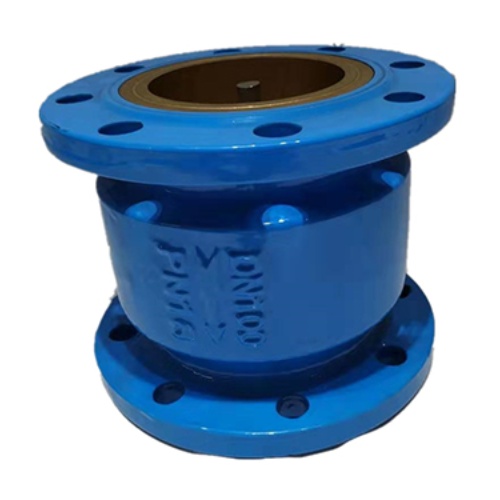
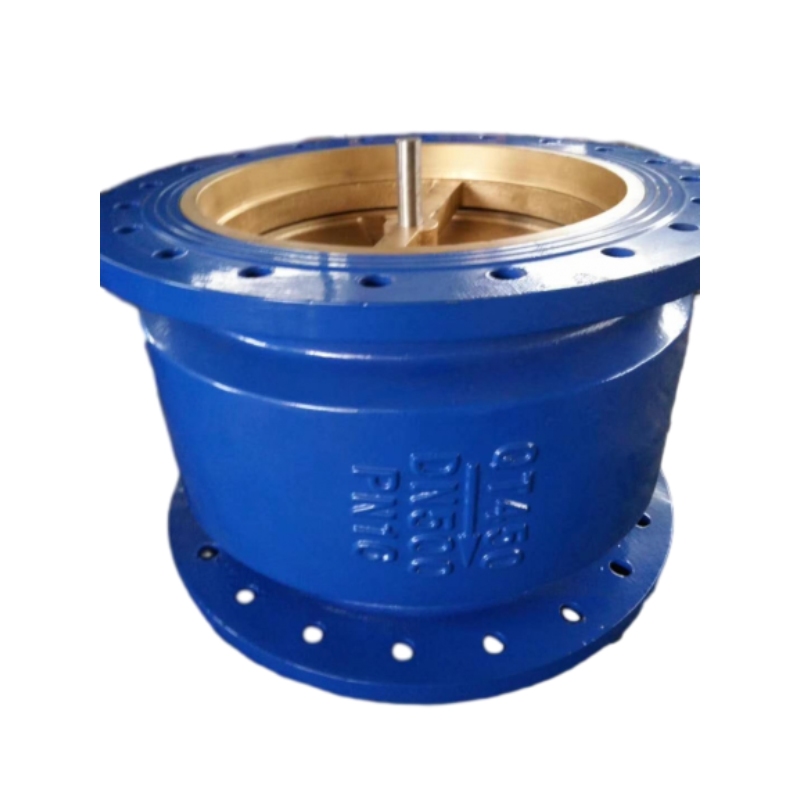
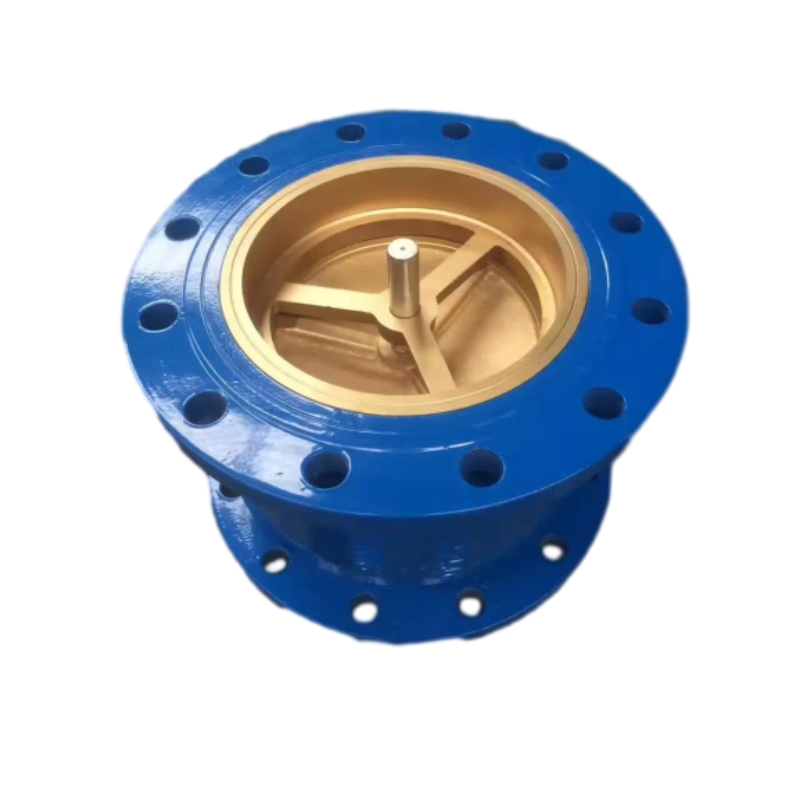
Product Classification
1. Rotary check valve: the valve flap is disc-shaped and rotates around the valve seat channel axis to achieve rotary motion. Because the flow channel is streamlined, the flow resistance is smaller than that of a lift/butterfly check valve. It is suitable for low flow rates and flow conditions with infrequent changes in large-caliber applications; however, it should not be used for pulsating flow. Its sealing performance is generally not as good as that of lift-type designs. Butterfly check valves are divided into single-valve, double-valve, and multi-valve types. These forms are mainly selected based on valve size, and their purpose is to prevent media from stopping flow or backflow, thereby weakening hydraulic shock.
2. Lift check valve: the valve slides along the vertical centerline of the valve body. A muffler check valve of this type can be installed only in horizontal pipelines. For high-pressure, small-diameter applications, a ball type may be used. The valve body shape of a muffler check valve is similar to that of a globe valve (and may be generalized as such), resulting in a larger fluid resistance coefficient. Its structure is similar to a globe valve, with the valve body and valve flap corresponding to a globe valve design.
The upper section of the valve flap and the lower section of the valve cover are machined with guiding sleeves. The valve flap can move freely up and down within the valve guide. When the medium flows downstream, the valve flap opens under the thrust of the medium. When the medium stops flowing, the valve flap seats by its self-gravity and prevents reverse flow by closing against the valve seat. For straight-through butterfly check valves, the inlet and outlet flow directions are perpendicular to the valve seat channel direction. For vertical lift check valves, the media inlet and outlet directions are the same as the valve seat channel direction, resulting in lower flow resistance than straight-through designs.
3. Tilting disk check valve: the valve flap rotates around a pin on the valve seat. Compared with a disc check valve, this structure is simpler and can be installed only in horizontal pipelines, while offering better sealing.
4. Muffled check valve: the valve flap moves along the centerline of the valve body. A pipeline check valve is an emerging valve category. It features compact size, light weight, and good processing technology, and represents one direction in check valve development. However, its flow resistance coefficient is slightly higher than that of a swing check valve.
5. Compression check valve: this valve is designed for boiler feedwater and steam shut-off service, and combines the integrated function of a lift check valve with a globe valve or angle valve. In addition, some designs are not intended for pump outlet installation, such as bottom valves, spring-loaded check valves, and Y-type check valves.
Structure diagram of energy-saving muffler check valve:
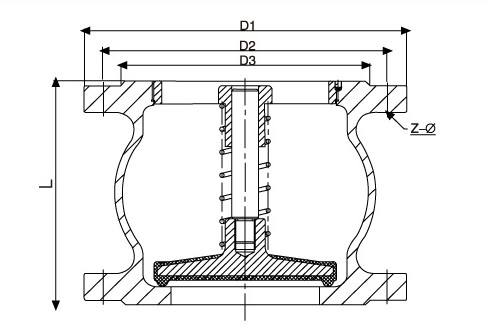
Product Parameter
DN (mm) | 40 | 50 | 65 | 80 | 100 | 125 | 150 |
L | 90 | 100 | 110 | 130 | 145 | 165 | 180 |
DN (mm) | 200 | 250 | 300 | 350 | 400 | 450 | 500 |
L | 200 | 220 | 240 | 260 | 280 | 300 | 320 |
Characteristic Uses
1. The valve body adopts a “waist drum” shape design to improve the medium flow direction and reduce the flow resistance coefficient.
2. The valve uses a short structural form. Although the head loss is slightly higher than that of a lift silencing check valve, the overall volume is small and the unit cost is lower.
3. Compact structure: a non-metallic lubrication sleeve is installed between the guide shaft and the guide frame, enabling flexible operation of the valve flap without any sticking phenomenon.
4. A skeleton rubber sealing ring is mounted directly in the valve body. This helps prevent long-term direct scouring of the sealing ring by the medium, significantly extending service life while providing a sturdy and durable structure.
5. Short opening and closing strokes of the valve flap effectively help prevent water hammer.
6. Suitable for water supply and drainage systems, as well as high-rise building networks. It can be installed at the pump outlet. With a slightly modified structure, it can also be used as a suction bottom valve; however, it is not suitable for sewage networks.
Principle structure
1. In operation, the media flow direction is as shown by the arrow.
2. When the media flows in the specified direction, the valve flap is opened by the force of the media. When the media flows counter to the specified direction, the valve flap is closed by its self-weight and the reverse force exerted by the media. As a result, the valve flap seals against the valve seat to prevent counterflow.
3. The sealing surfaces of the valve body and valve flap are welded with stainless steel.
4. The structural length conforms to the GB/T 12221-2005 standard, and the flange connection conforms to the GB/T 17241.6-2008 standard.
Installation and use
1. Before installation, ensure that both ends of the valve are sealed. Store the valve in a dry and ventilated indoor environment. If stored for an extended period, inspect frequently to prevent rust and corrosion.
2. Clean the valve before installation and remove any defects that may have occurred during transportation.
3. During installation, carefully check the valve markings and nameplates to ensure compliance with the intended operating requirements.
4. Install the valve on the horizontal pipeline with the bonnet facing upward.
Silent Check Valve FAQs
What is a silent check valve, and how does it work?
A silent check valve is a mechanical device that allows fluid to flow in one direction while preventing backflow. It operates using a hinged disc and/or a spring mechanism that opens when the inlet-side fluid pressure exceeds the outlet-side pressure. As flow decreases or reverses, the valve closes quietly, minimizing water hammer and vibrations—making it suitable for both residential and industrial applications.
What materials are the silent check valves made from?
Our silent check valves are made from high-quality materials such as brass and stainless steel, depending on the specific model. These materials are selected for durability and corrosion resistance to support long service life and reliable performance in various fluid transport systems.
Can I install the silent check valve in any orientation?
While silent check valves are designed for practical use, installation should always follow the manufacturer’s instructions. Typically, these valves should be installed in a horizontal position, with the flow direction indicated by an arrow on the valve body. This supports optimal performance and helps prevent backflow issues or premature wear.
How does the silent check valve minimize noise and water hammer?
Silent check valve design includes features that reduce noise and water hammer effects. The valves use a slow-closing mechanism that seats the disc gently into the valve body instead of shutting abruptly. This gradual closure reduces turbulent flow and helps minimize hydraulic shock, supporting quieter operation and extending the service life of your piping system.
What applications are suitable for using silent check valves?
Silent check valves are suitable for a wide range of applications, including plumbing systems, irrigation, wastewater management, and industrial fluid handling processes. They are especially beneficial where noise reduction is a priority or where backflow could disrupt operations. For both residential and commercial use, these valves provide efficient and dependable fluid control.
How can I determine the right size of silent check valve for my system?
To determine the correct size of a silent check valve, start by assessing the pipe size and the fluid flow rate. The valve size should match the nominal pipe size to ensure proper flow and avoid unnecessary restrictions. In addition, consider the pressure rating and compatibility with the fluid type. If you need support, our team can assist you in selecting the most suitable option for your requirements.