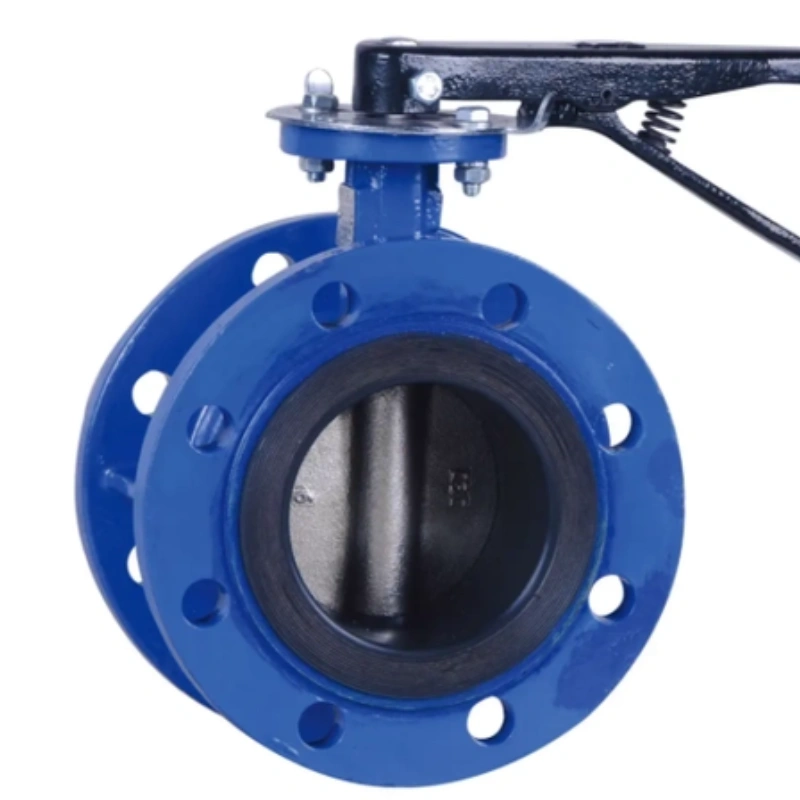

Butterfly Valves
The butterfly valve, also known as a throttle valve, is an important component in water supply and drainage systems. When selecting a valve, consider working conditions, the type of butterfly valve, the materials used, and the connection method to match design and performance requirements. A well-informed selection helps ensure optimal operation in your piping system.
Product Content
Centerline butt-clamp soft-seal butterfly valve; double-eccentric flanged butterfly valve with a compact design. 90° rotary operation is easy, sealing is reliable, and the service life is long. It is widely used in water mills, power plants, steel mills, papermaking, the chemical industry, catering and other water supply and drainage systems, serving as both a regulator and an on/off shut-off valve.
Product Description
Butterfly valve, commonly referred to as a butterfly valve, is a type of valve in which the closing member (valve disc or butterfly plate) rotates around the valve axis to open and close or regulate flow. In pipelines, it is mainly used for isolation and throttling. The butterfly valve’s opening and closing member is a disc-shaped butterfly plate that rotates around its own axis within the valve body, enabling opening/closing and flow regulation. Full-open to full-closed operation is usually less than 90°. Since the butterfly stem itself does not provide self-locking, the butterfly plate is positioned by installing it on the valve stem worm-gear reducer. Using a worm-gear reducer not only provides the butterfly plate with self-locking capability—allowing it to stop in any position—but also improves operating performance.
Industrial special butterfly valves are designed to withstand high temperatures and offer a wider applicable pressure range. With large nominal diameters, their valve bodies are typically made of carbon steel, and the sealing ring on the valve plate is made of a metal ring rather than a rubber ring. Large high-temperature butterfly valves are manufactured from welded steel plate and are mainly used in high-temperature flue-gas ducting and gas pipelines.
Three Core Technical Designs of High-Performance Butterfly Valves
STORAEN’s butterfly valves redefine industrial flow control through innovative engineering. By combining precision sealing, material resilience, and smart actuation, they deliver outstanding performance across diverse applications. As a leading provider of butterfly valve types and solutions, our designs address the key challenges of leakage, wear, and operating efficiency. Below are the three core technologies that set our butterfly valves apart.
1. Eccentric Sealing Systems for Zero-Leak Performance
The heart of our high-performance butterfly valve lies in its advanced eccentric designs, eliminating common leakage issues found in traditional valves:
Double Eccentric Geometry: An offset disc axis (1st eccentricity) and seat angle (2nd eccentricity) form a “line-contact” seal when closed, reducing friction by 40% compared with concentric models (reference value). This design provides bubble-tight shutoff for gases and liquids, even at high pressures (up to PN16.0MPa), making it ideal for butterfly valve applications in chemical pipelines and steam systems.
Triple Eccentric Innovation: For extreme conditions (450°C+ flue gas or abrasive media), our triple-eccentric valves add a third offset (disc-face tilt). This allows metal-to-metal sealing without seat wear. This technology extends beyond the limitations of globe valves for high-temperature isolation, ensuring long-term reliability in power-plant exhaust systems.
2. Material Science for Harsh Environment Resilience
We engineer valve components to withstand the toughest working conditions by matching butterfly valve types to specific media requirements:
Body & Disc Materials: Choose from HT300 cast iron (cost-effective for water/gas, -10°C~200°C), WCB carbon steel (heavy-duty industrial use, -29°C~425°C), or 316L stainless steel (corrosion-resistant for chemicals, -40°C~450°C). Our 6-inch and 4-inch butterfly valves feature thickened disc ribs to prevent deformation under high flow velocity, delivering cycle life that outperforms standard designs by 25% (reference value).
Seal Combinations: Soft seals (NBR/EPDM) provide ≤0.1 mm leakage tolerance for water and wastewater, while hard seals (stainless steel + graphite) handle particle-laden media without erosion—critical for mining slurry or cement plants.
3. Intelligent Actuation for Precision Control
Our butterfly valves integrate advanced mechanisms to enhance operational efficiency and safety:
Worm Gear Reducers: Standard on manual valves, these provide 5:1 torque multiplication and self-locking capability, enabling easy 90° operation even for 12-inch diameters and eliminating backdriving risks in vertical pipelines.
Automation-Ready Design: Pneumatic, electric, or hydraulic actuators can be mounted directly to ISO 5211 top flanges. They support fail-safe positions (open/close/hold) and include 4–20 mA feedback for PLC integration. This makes our valves well-suited for automated processes, reducing response time by 30% compared with legacy globe-valve systems (reference value).
Elevate Your Flow Control with STORAEN
From water distribution to high-temperature industrial processes, our butterfly valves deliver the precision, durability, and adaptability your system requires. With innovative sealing, premium materials, and smart actuation, we have transformed the butterfly valve from a simple shut-off device into a high-performance flow-control solution. Explore our butterfly valves for sale today and experience the difference engineering excellence brings—because in flow control, performance is everything.
STORAEN Butterfly Valves: Custom Solutions and Quality Assurance
STORAEN redefines industrial flow control with tailored butterfly valve solutions and uncompromising quality standards. This ensures each valve meets your specific operational requirements. From material selection to performance certification, our butterfly valve types combine engineering flexibility with rigorous quality assurance. Here’s how we deliver the right performance for your needs.
Customization: Engineered to Your Exact Specifications
1. Tailored Sizing & Configurations
Covering DN40 to DN1200, our 4-inch butterfly valve and 6-inch butterfly valve models (and beyond) adapt to pipe networks of any scale. For non-standard sizes, we create custom diameters for unique installations—from compact HVAC systems to large industrial pipelines.
Choose from wafer, lug, flanged, or welded connections to match ASME, DIN, or JIS standards, helping eliminate adapter-related issues in global projects.
2. Material & Seal Optimization
Body Materials: Select HT300 cast iron (for water/gas), WCB carbon steel (for heavy-duty industry), or 316L stainless steel (for corrosion resistance) for media in the range of -40°C to 450°C.
Seal Types: Soft seals (NBR/EPDM) for water/wastewater (≤0.1 mm leakage tolerance, reference value), or hard metal seals (stainless steel + graphite) for high-temperature/flue-gas applications—delivering improved durability in abrasive conditions compared with globe valves.
3. Actuation & Functionality
Manual (worm gear), pneumatic, electric, or hydraulic actuators with ISO 5211 mounting ensure precise control. Add fail-safe mechanisms (air-to-open/close) or 4–20 mA feedback for automated processes.
Specialized designs: Cryogenic valves (-196°C), high-vacuum models, or fire-safe configurations for safety-critical applications.
Uncompromising Quality: From Design to Delivery
1. Rigorous Testing Regime
Hydrostatic Tests: 1.5× pressure rating for shells and 1.1× for seats, verifying zero leakage.
Cycle Testing: 5,000+ operations for soft seals and 10,000+ for hard seals—demonstrating durability beyond industry norms (as stated in the source content).
Material Traceability: Each component includes a mill certificate, ensuring compliance with chemical resistance and temperature requirements.
2. Warranty & After-Sales Support
1-year warranty covering seal performance and mechanical defects, with 24/7 technical support for installation, maintenance, and troubleshooting.
Spare parts availability: Quick delivery of replacement seats, discs, or actuators to minimize downtime—ideal for customers purchasing butterfly valves for sale in bulk.
Why Choose STORAEN for Custom Butterfly Valves?
Application Expertise: Whether you need a concentric butterfly valve for water treatment or a triple-eccentric model for petrochemical plants, our engineers align the butterfly valve type and application to your exact process parameters.
Total Cost Efficiency: Customized solutions help reduce costs associated with over-engineering, while durable designs reduce maintenance by 30% compared with generic valves (reference value).
Elevate Your System with Tailored Precision
Don’t settle for off-the-shelf solutions when your operations require excellence. STORAEN’s custom butterfly valves—supported by rigorous quality assurance—deliver the performance, reliability, and adaptability your projects demand. Explore our butterfly valves for sale today and discover how tailored engineering transforms flow control.
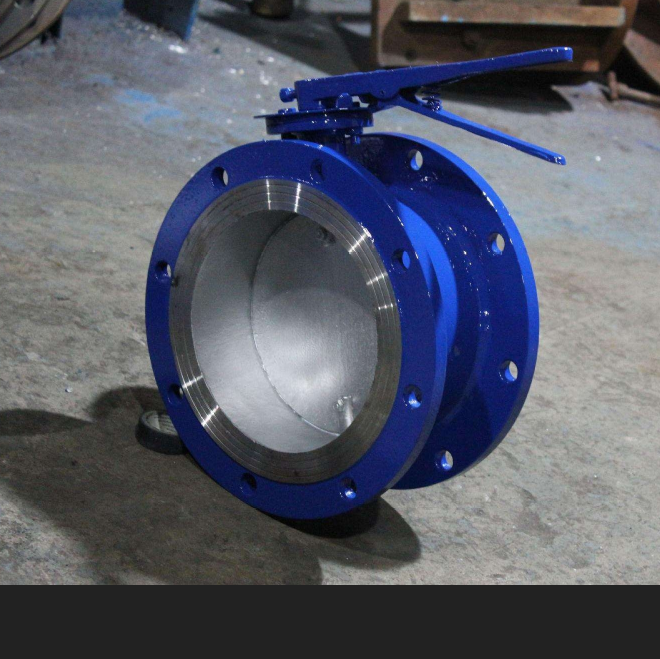
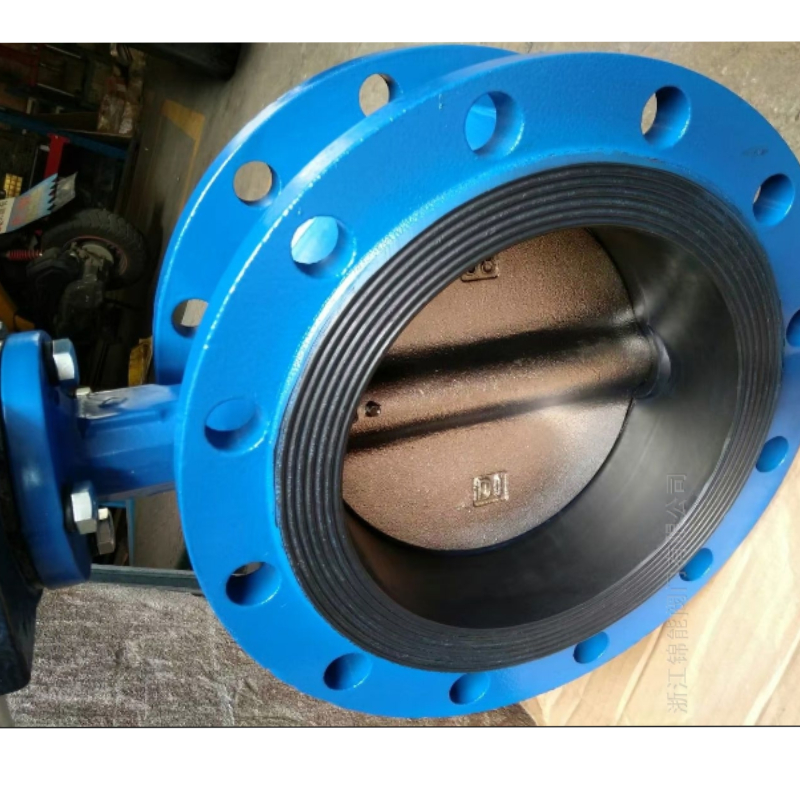
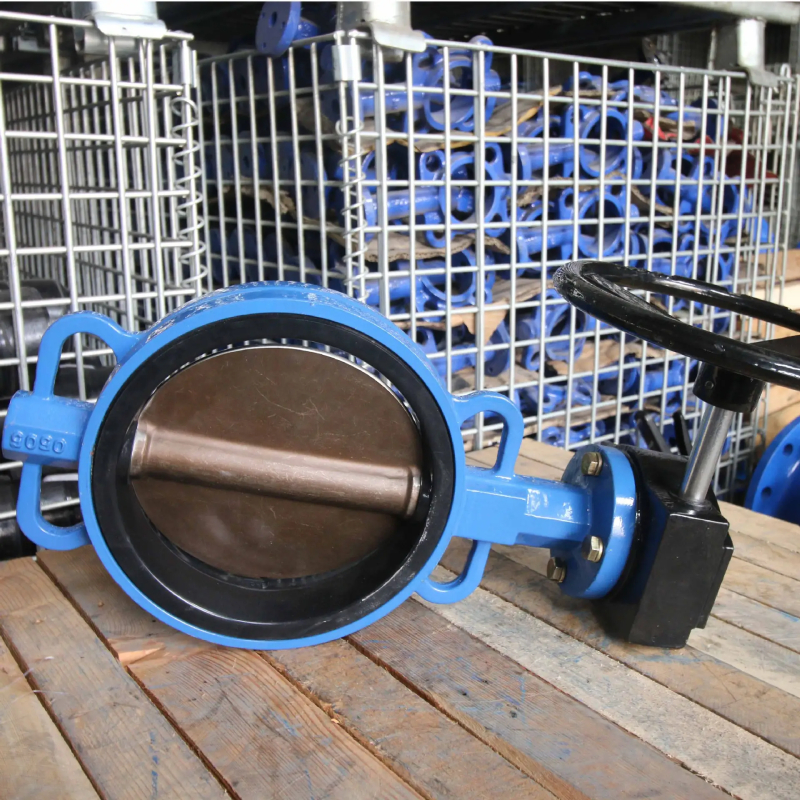
Product Detail Drawing
Product Classification
Classification by structural form
(1)Center-sealed butterfly valve
(2)Single-eccentric sealed butterfly valve
(3) Double-eccentric sealed butterfly valve
(4) Three-eccentric sealed butterfly valve
Classification by sealing surface material
(1) Soft-seal butterfly valve:
1) Sealing by non-metallic soft material to non-metallic soft material.
2) Sealing by metal hard material to non-metallic soft material.
(2) Metal-hard-seal butterfly valve: sealing by metal hard material to metal hard material.
Classification by sealing form
(1) Forced-seal butterfly valve
1) Elastic-seal butterfly valve. Sealing specific pressure is generated when the valve plate extrudes the valve seat upon closing, and the elasticity of the valve seat or valve plate is also involved.
2) External-torque sealed butterfly valve. Sealing pressure is generated by the torque applied to the valve shaft.
(2) Pressure-assisted seal butterfly valve. The sealing specific pressure is generated by the valve seat or valve plate on the poppet sealing element filling pressure.
(3) Automatic-sealing butterfly valve. Sealing pressure is automatically generated by the medium pressure.
Classification by working pressure
(1) Vacuum butterfly valve. Working pressure below the standard atmospheric pressure-rated butterfly valve.
(2) Low-pressure butterfly valve. Nominal pressure PN <1.6 MPa.
(3) Medium-pressure butterfly valve. Nominal pressure PN 2.5–6.4 MPa.
(4) High-pressure butterfly valve. Nominal pressure PN 10.0–80.0 MPa.
(5) Ultra-high-pressure butterfly valve. Nominal pressure PN >100 MPa.
Classification by operating temperature
(1) High-temperature butterfly valve. t>450°C.
(2) Medium-temperature butterfly valve. 120°C
Classification by connection
(1) Butt-clamp butterfly valve.
The butterfly plate of the butt-clamp butterfly valve is installed in the pipe diameter direction. Inside the cylindrical passage of the valve body, the disc-shaped butterfly plate rotates around the axis. The rotation angle is between 0° and 90°. When rotated to 90°, the valve is fully open.
Butterfly valves are simple in structure, compact in size, and lightweight, consisting of only a few components. They can be opened and closed quickly with only a 90° rotation, enabling simple operation. At the same time, the valve provides good fluid control characteristics. When the butterfly valve is fully open, the thickness of the butterfly plate is the only resistance encountered by the medium as it passes through the valve body; therefore, the pressure drop generated by the valve is very small, resulting in good flow-control performance. Butterfly valves have two types of sealing: elastic seals and metal seals. For elastic-seal valves, the seal can be installed in the valve body or attached around the butterfly plate.
(2) Flanged butterfly valve.
Flanged butterfly valves use a vertical-plate structure. The valve stem on the integral metal hard-seal valve uses a sealing-ring composite structure composed of a flexible graphite plate and a stainless-steel plate, mounted on the valve body. The butterfly plate sealing surfaces are welded with stainless steel. For soft-seal valves, the sealing ring is made of nitrile rubber and is installed on the butterfly plate.
(3) Lug-type butterfly valve.
(4) Welded butterfly valve.
Welded butterfly valves are non-closed-type butterfly valves and are widely used in building materials, metallurgy, mining, electric power, and other production processes. They are used to connect, open/close, or adjust the amount of media in pipelines with medium temperature ≤300°C and nominal pressure of 0.1 MPa.
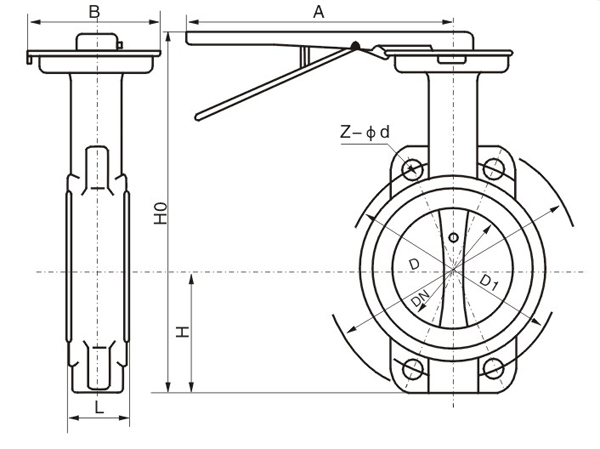
Clamped soft-seal butterfly valve main outline connection dimensions. Unit: mm
Product Parameter
|
DN |
L |
H |
HO |
A |
B |
0.6MPa |
1.0MPa |
1.6MPa |
|||
|
DO |
n-d |
DO |
n-d |
DO |
n-d |
||||||
|
50 |
43 |
63 |
235 |
270 |
110 |
110 |
4-14 |
125 |
4-18 |
125 |
4-18 |
|
65 |
46 |
70 |
250 |
270 |
110 |
130 |
4-14 |
145 |
4-18 |
145 |
4-18 |
|
80 |
46 |
83 |
275 |
270 |
110 |
150 |
4-18 |
160 |
8-18 |
160 |
8-18 |
|
100 |
52 |
105 |
316 |
270 |
110 |
170 |
4-18 |
180 |
8-18 |
180 |
8-18 |
|
125 |
56 |
115 |
340 |
310 |
110 |
200 |
8-18 |
210 |
8-18 |
210 |
8-18 |
|
150 |
56 |
137 |
376 |
310 |
110 |
225 |
8-18 |
240 |
8-22 |
240 |
8-22 |
|
200 |
60 |
164 |
430 |
353 |
150 |
280 |
8-18 |
295 |
8-22 |
295 |
8-22 |
|
250 |
68 |
206 |
499 |
353 |
150 |
335 |
12-18 |
350 |
12-22 |
355 |
12-26 |
|
300 |
78 |
230 |
570 |
380 |
150 |
395 |
12-22 |
400 |
12-22 |
410 |
12-26 |
What Is a Butterfly Valve Used For?
A butterfly valve is a type of quarter-turn valve that uses a rotating disc to regulate fluid flow. Its design includes features that make it suitable for specific applications across various industries, including water supply, wastewater treatment, chemical processing, and HVAC systems. Understanding the functionality and benefits of a butterfly valve helps you make informed decisions for different operating scenarios.
One primary purpose of a butterfly valve is to control the flow of liquids and gases. The disc pivots around a central axis, enabling fast and efficient operation. This quarter-turn mechanism is particularly beneficial when rapid adjustments to flow rates are required. For example, in water treatment plants or industrial applications where precise flow control is critical, a butterfly valve can provide an effective solution.
In addition, butterfly valves are valued for their lightweight and compact construction. Compared with other valve types, they take up less space, making them suitable for installations in tight areas or where weight is a key consideration. Whether used in pipelines or confined locations, the butterfly valve’s minimalist design supports versatility without compromising performance.
Another important application of a butterfly valve is system isolation. When the disc is fully closed, the valve forms a tight seal to prevent fluid flow. This is especially useful during maintenance, when sections of a pipeline must be isolated. The quick and reliable shut-off capability makes butterfly valves essential components for controlling systems and supporting safety in industrial processes.
In summary, butterfly valves are used in many applications to regulate flow, isolate systems, and improve operational efficiency. Their compact design, quick operation, and reliability make them a popular choice across industries. Understanding what a butterfly valve is used for helps you appreciate its critical role in fluid control and management—whether you are involved in engineering, maintenance, or industrial design.
The Advantages of Butterfly Valves
One key advantage of butterfly valves is their compact design. Unlike traditional valves that are often bulky, butterfly valves consist of a simple disc mounted on a shaft. This streamlined structure enables installation in tight spaces, making them ideal for projects with limited room for equipment. Their lightweight construction also reduces the overall weight of piping systems, simplifying handling and installation.
Another major benefit is quick operation. The design enables rapid opening and closing, with full movement requiring only a 90° rotation. This is particularly valuable in applications where timely flow control is essential, such as water treatment facilities and chemical processing plants. The fast response of butterfly valves helps improve operational efficiency and reduce downtime.
Moreover, butterfly valves provide effective flow regulation. When partially open, they create a relatively streamlined flow path while controlling the media passing through. This characteristic is important in applications where precise flow management is required to maintain consistent system performance.
Butterfly valves also offer durability and low maintenance requirements. Constructed from robust materials such as stainless steel or PVC, they resist corrosion and are suitable for a wide range of substances, including aggressive chemicals and corrosive environments. The simple mechanism reduces the likelihood of mechanical failure, further lowering maintenance demands and operating costs.
Finally, butterfly valves are adaptable across many industries. From HVAC systems to water supply and wastewater treatment, these valves handle a broad range of fluids, increasing their usefulness in multiple applications.
What Is the Difference Between a Gate Valve and a Butterfly Valve?
Operating Mechanism
The primary difference between gate valves and butterfly valves is their design and operating mechanism. A gate valve uses linear motion to lift or lower a gate to control flow. This mechanism is well-suited for on/off isolation but is not ideal for throttling. In contrast, a butterfly valve features a rotating disc that pivots around a central shaft to regulate flow. This design allows for quick operation and is particularly effective for throttling applications.
Flow Control and Efficiency
Another important distinction is the flow characteristics. Butterfly valves are known for delivering relatively consistent flow rates with minimal pressure drop, which is advantageous in large-volume applications and where space is limited. Gate valves are generally less efficient for throttling and can generate turbulence, which may reduce performance in high-flow conditions.
Space and Weight Considerations
Butterfly valves are typically more compact and lighter than gate valves. This space-saving design makes them suitable for installation in tight spaces where traditional gate valves may be difficult to accommodate. The reduced weight also makes installation and maintenance simpler.
Application Suitability
Both valve types have specific applications where they perform best. Gate valves are commonly used in systems that require minimal pressure loss and where full isolation is critical. Butterfly valves are preferred where quick operation and frequent flow adjustments are required, making them suitable for HVAC systems, water distribution, and wastewater treatment.
What Are the Three Types of Butterfly Valves?
1. Concentric Butterfly Valves
Concentric butterfly valves have a straightforward design in which the disc is aligned eccentrically with the valve body. In this configuration, the disc rotates around an axis that is parallel to the fluid flow. Concentric butterfly valves are mainly used in low-pressure applications and are well-suited for water and wastewater treatment. Their simple design supports efficient flow control with minimal pressure drop, ensuring reliable performance in a wide range of applications.
2. Eccentric Butterfly Valves
Eccentric butterfly valves, also known as high-performance butterfly valves, feature a design that offsets the disc from the valve seat. This improves sealing performance and reduces wear on valve components. Eccentric butterfly valves are suitable for more demanding applications involving higher pressures and temperatures. They perform well in services such as slurry handling, corrosive fluids, and other challenging media, supporting long-lasting operation and reliability.
3. Double Eccentric Butterfly Valves
Double eccentric butterfly valves, also referred to as triple-offset butterfly valves, extend the eccentric design further. With two offsets—one for the disc’s rotation and one for the sealing surface—these valves provide enhanced performance, especially under demanding conditions. The double-eccentric arrangement reduces friction between the disc and seat, enabling a tight seal with less wear than traditional valve designs. They are ideal for high-pressure, high-temperature applications and are commonly used in industries such as oil and gas, power generation, and pharmaceuticals.